Award: Research & Development Grant
Discipline: Visual Arts
Project Collaborator(s):
For me, a community of practice is, who am I accountable for? How am I doing the work? Who am I going to work for? So it’s very important to keep the integrity of how we do the work, where do we do the work, and what conversations are we having.
Excerpt from Carolina Aranibar-Fernández’s R&D Grant application
In her multi-media installations, Bolivia-born artist Carolina Aranibar-Fernandez returns again and again to three inter-related themes: the extraction and exploitation of natural resources; invisible and forced labor, particularly the labor of women; and the flow of capitol. Recently, these interests have led her to the Arizona-Sonora border. Her R&D Grant will allow her to delve deeper into the region, its culture, and its economy. This research will inform the development of an expansive, binational installation piece the artist calls In Place. The installation will span the border, with components in both Douglas, Arizona, and its Mexican counterpart, Agua Prieta, and will be created in close collaboration and dialogue with residents of both communities.
Prior to receiving her grant, Aranibar-Fernandez had already established deep roots in the region, including work with Border Arts Corridor (BAC), a Douglas-based organization devoted to creating opportunities for cross-border dialogue and exchange through the arts, and a collective of craftswomen in Agua Prieta. Grant funds will enable the artist to maintain and build on these connections. BAC will be an important partner in the realization of In Place, while the women’s collective, working alongside the artist as paid collaborators, will participate in the creation of objects that will populate the installation.
The grant will further allow Aranibar-Fernandez to conduct research into the region’s mining industry, those employed by it, and those displaced by it. This research will include visits to Cananea, North America’s largest copper mine, and the gathering of oral histories from individuals who worked in the mine. Research into immigration and displacement will be supported through the involvement of Dr. Michelle Téllez, an assistant professor in the Department of Mexican American Studies at University of Arizona.
Ultimately, Aranibar-Fernandez sees this effort as an opportunity to not merely build a body of work, but to work closely within a community, learning from and with members of that community, to ethically create work that genuinely reflects the community.
Work Samples
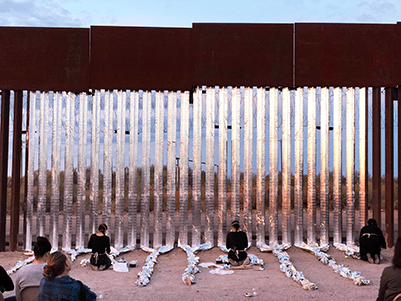
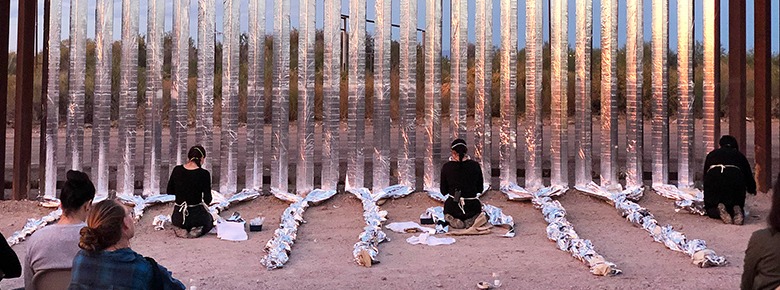
Trenzando, by Carolina Aranibar-Fernandez. 2019.
Location: Border fence between Douglas, Arizona and Agua Prieta, Sonora.
Collaborators: Mary Jenea Sánchez, Laura Alfonso Baron, Martha Rascon Coronado, Carolina Aranibar-Fernandez.
“Trenzando is a durational performance media-installation focusing on the exploitation of natural resources used to sustain capitalist systems and women’s invisible labor used to maintain these systems. The fabrics have been dyed with extracted resources, all of which connect to my lived experience as well as to the connected resources we use globally. These materials include: Coca leaves, copper metal, and crude oil. I use the “emergency blanket” aluminum, commonly used in deportation centers along the US / MX border to wrap women and children. The act of braiding is practiced in many traditions to prevent negative energy from entering the body as a form of healing.”
Photo by Katie Ann Franklin
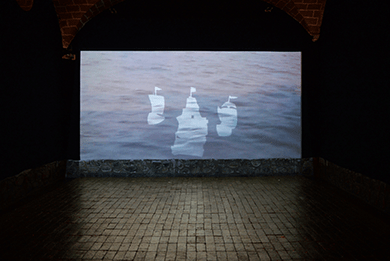
Lineas del Agua, by Carolina Aranibar-Fernandez. 2017.
Lineas del Agua is a multi-media Installation focused on destruction and ‘re-construction’, displacement and the hierarchies of power over natural resources, and bodies of water the ocean– where commodities are moved from one place to be consumed on other.”
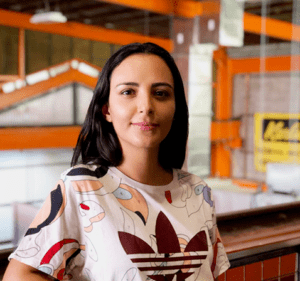 Carolina Aranibar-Fernandez, born and raised in La Paz- Bolivia, currently lives and works in Arizona, U.S. Her practice addresses geopolitical concerns of exploitation, as it relates to natural resource control and the invisible labor that supplies global trade. Drawing references from myths and oral story telling; her work interweaves textiles, video, pottery to create multimedia installations that explore historical and contemporary exploitation/extraction, privatization and labor . Aranibar-Fernandez’s recent work has been exhibited at the National Museum of Art in Bolivia, New York, Qatar, and in the 2017 Kathmandu triennial in Nepal. Received an M.F.A from Virginia Commonwealth University and a B.F.A from the Kansas City Art Institute. She is currently the resident artist for the 2019 – 2020 Binational Arts Residency and works both in Arizona (US) and Sonora (MX). She received the 2018-2019 Projecting All Voices Fellowship at the Herberger Institute for Design and the Arts at Arizona State University. Recipient of the 2016-2017 Fellowship at the Virginia Commonwealth University in Qatar.